Quick Answer
What is electricity? In short, it is the flow of electric charge, usually electrons, through a conductor such as a copper wire. That flow can then be made to do work: for example, it can light a room, spin a motor or heat water. In Australia, homes receive alternating current at 230 volts and 50 hertz, which is delivered through a network of power stations, transmission lines, substations and street poles.
230V
Australian Mains Voltage
50Hz
Grid Frequency
3 Months
Safety Switch Test Cycle
Licensed
Electrical Work Only
Understanding AC vs DC Power
Every device in your home runs on one of two kinds of current. The grid delivers one, while most electronics quietly convert it to the other. Meanwhile, a rooftop solar system does both.
Alternating Current (AC)
The current changes direction 50 times a second, which is the 50 hertz on your bill. Because AC is easy to step up and down with transformers, the grid uses it to move power over long distances.
Direct Current (DC)
In contrast, direct current flows in one direction only. Batteries, solar panels, phone chargers and the LEDs inside your downlights all work on DC. For instance, the small box on a charger converts AC from the wall into DC.
Where the Two Meet
A solar inverter turns the DC produced by panels into AC that your home and the grid can use. Similarly, a home battery stores DC, and an EV charger manages the conversion for your car.
If you are weighing up panels or a battery, then our solar services page explains how the conversion fits into a household system.
The Journey of Electricity to Your Home
What is electricity doing between the power station and your kettle? In essence, it passes through five stages, and the voltage changes at almost every one of them.
1. Generation
Coal, gas, hydro, wind and solar farms, as well as millions of rooftops, generate power. Most large generators produce AC at a few thousand volts.
2. Transmission
Next, transformers step the voltage up to tens or hundreds of thousands of volts. Higher voltage means less energy is lost as heat over long distances.
3. Substations
Closer to towns, substations then step the voltage back down and route power into the local distribution network.
4. Distribution
Poles and underground cables carry power through the suburbs. Finally, a local transformer, often the grey box on a pole, reduces it to 230 volts for homes.
5. Your Meter and Switchboard
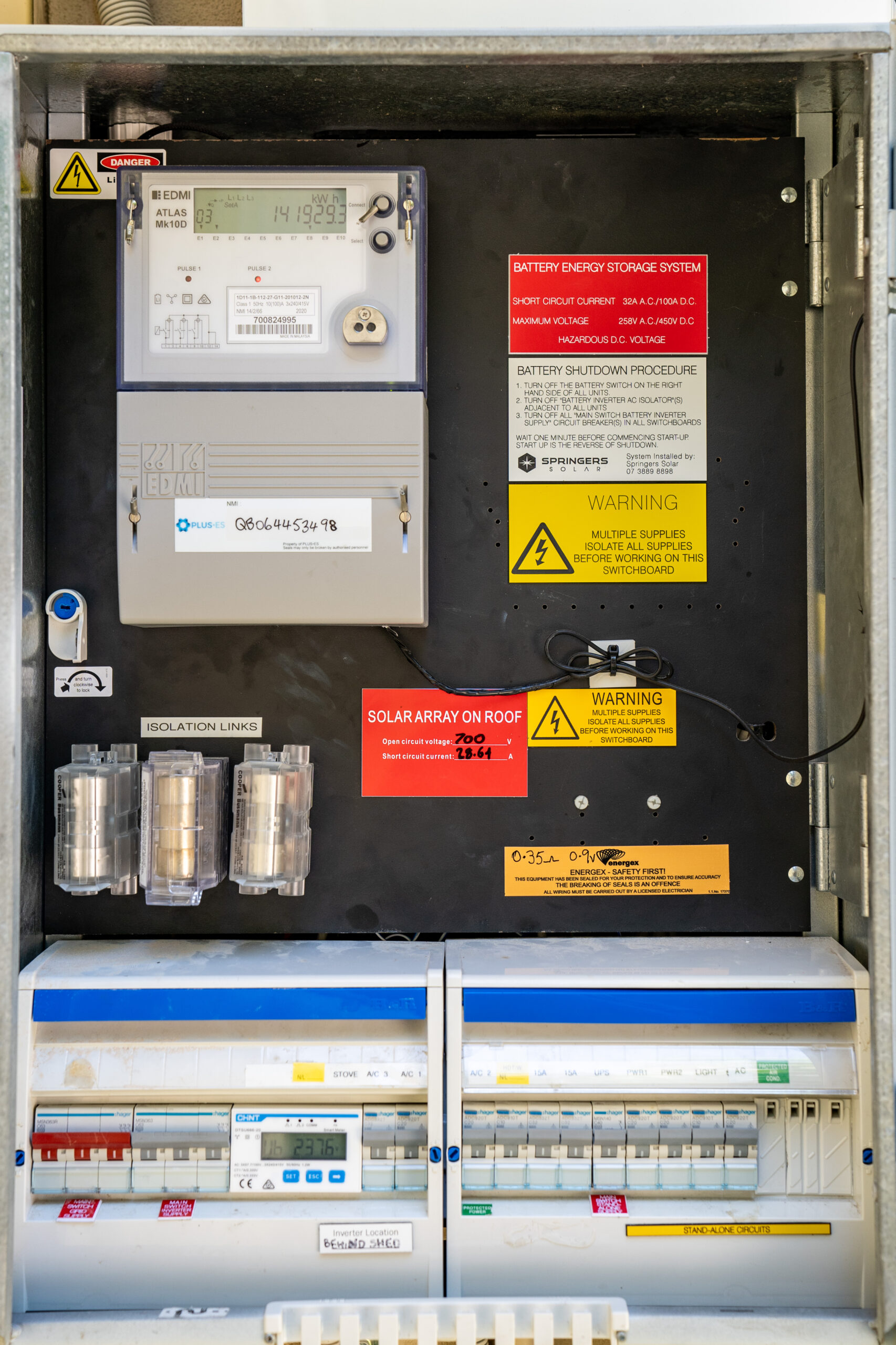
Power enters through the meter, then passes the main switch, safety switches and circuit breakers on your switchboard. These split it into the circuits that feed each part of the home.
In South East Queensland, the poles, wires and transformers in stages three and four are run by the local distributor. As a result, a street-wide outage is reported to them rather than to your electricity retailer.
Basic Electrical Concepts Explained Simply
Most people who ask what is electricity are really asking what the words on their bill and their switchboard mean. Fortunately, if you think of water in a pipe, then the terms fall into place.
Voltage (Volts)
The pressure pushing the charge along, like water pressure in a pipe. Australian mains is 230 volts, and consequently it can push current through your body with ease.
Current (Amps)
How much charge is flowing, like the volume of water moving through the pipe. Circuit breakers are rated in amps, so they trip when a circuit draws too much.
Resistance (Ohms)
How much a material resists the flow. Copper has low resistance, so it is used for wiring. A heater element, on the other hand, has high resistance, which is exactly what turns current into heat.
Power (Watts)
The rate at which energy is used: volts multiplied by amps. For example, a 2,400 watt kettle draws about 10 amps from a 230 volt outlet.
Energy (Kilowatt Hours)
Power over time, and the unit you are billed for. Therefore, running that 2,400 watt kettle for an hour uses 2.4 kilowatt hours.
Circuits and Earth
Electricity needs a complete loop to flow. The earth wire gives fault current a safe path to the ground, so a safety switch can cut the power before anyone is hurt.
Essential Electrical Safety Tips for Homeowners
Electricity is safe as long as it stays inside the wires and the fittings designed for it. These habits keep it there.
- Do not do your own electrical work. In Queensland, it is illegal for anyone without a licence to carry out electrical work, and that includes replacing a power point or a light switch.
- Test your safety switches every three months. Press the test button on the switchboard, and the switch should trip instantly. If it does not, or if you have none, then call a licensed electrician.
- Do not overload power boards. Heaters, kettles and other high-draw appliances should plug straight into the wall, never into a chain of double adaptors.
- Keep water and electricity apart. Dry your hands before touching switches, and never use appliances near a full sink or bath.
- Check cords and plugs regularly. Frayed cords, warm plugs, scorch marks or a burning smell mean stop using it immediately and, of course, get it looked at.
- Know your main switch. Above all, everyone in the house should know where the switchboard is and how to turn the power off in an emergency.
An older switchboard without safety switches on every circuit is the most common weakness we find in Brisbane homes. For that reason, NG Trade Solutions’ licensed electricians carry out electrical inspections, install safety switches and complete switchboard upgrades as part of our full range of electrical services for homes and businesses.
If something in your home does not seem right, contact our team for honest, obligation-free advice.
Frequently Asked Questions
Common questions about electricity from Brisbane homeowners.
What is electricity measured in?
It depends on what you are measuring. Voltage is measured in volts, current in amps, resistance in ohms and power in watts. Your bill, however, charges you for energy, which is measured in kilowatt hours: power multiplied by the time it was used. For example, a 10 watt LED downlight running for 100 hours uses one kilowatt hour.
Is 230 volts dangerous?
Yes. Australian mains voltage can deliver a fatal shock, and the risk rises when skin is wet or when there is no safety switch to cut the power quickly. This is why electrical work is restricted to licensed electricians in Queensland, and also why safety switches on every circuit matter so much.
Why does my safety switch keep tripping?
A safety switch trips when it detects current leaking to earth. Usually that means a faulty appliance, damaged wiring or moisture in a fitting. To find the culprit, unplug appliances one at a time. However, if the switch trips with nothing plugged in, or trips repeatedly, have a licensed electrician investigate rather than resetting it and hoping.